The Chinese sexagenary (60-year) cycle – Gānzhī 干支
Dates are incredibly important when doing genealogy. They are used to calculate ages, understand a person’s place in their country’s timeline of events, and figure out connections between individuals and families; without them, a name feels adrift in history.
However, understanding ancient Chinese dates can be challenging for those used to using a Western calendar (usually the Gregorian calendar). The ones I have encountered typically give the year of an event as a four-character combination: the two-character reign title of the emperor, and then a two-character year based on the Chinese sexagenary cycle, known as the gānzhī 干支. This sixty-year cycle is created by combining 10 ‘heavenly stem’ characters with 12 ‘earthly branch’ characters. There is a pattern to the combination that means half of the pairs do not get used, creating 60 different terms in a repeating cycle that are used to refer to a specific year in the lunar calendar.
Since the lunar year does not completely line up with the Western calendar years (with the lunar year starting later and going beyond the end of the Western calendar year), the most accurate dates will also include the month and day. Those born at the end of a lunar year may actually have been born in the following Western calendar year compared to those born a month earlier. Similarly, those born at the beginning of a Western calendar year may find that their birthdate still falls within the prior year’s lunar calendar.

In the image above, the blue characters are all of the heavenly stem characters 天干 (tiān gān), while the red characters are all of the earthly branches 地支 (dì zhī). Since this cycle repeats every sixty years, the name of the reigning emperor or some other historical indicator is critical in being able to convert it to a Western calendar year.
As an example, let’s say that a date given for one of my ancestor’s birthdates starts with 公生乾隆乙丑. The 公 character is pronounced gōng and in this case is an honorific referring to a respected male relative. 生 (shēng) means ‘born’, so the actual date doesn’t start until the next characters: 乾隆乙丑. The first two are the reign title of the Emperor Qiánlóng, and the second set of two characters are the gānzhī. Usually putting this four character combination into a Google search will bring up the Chinese wikipedia article on that emperor, which will contain a table that shows the reign year, the Western calendar year, and the gānzhī year. It will look something like this:
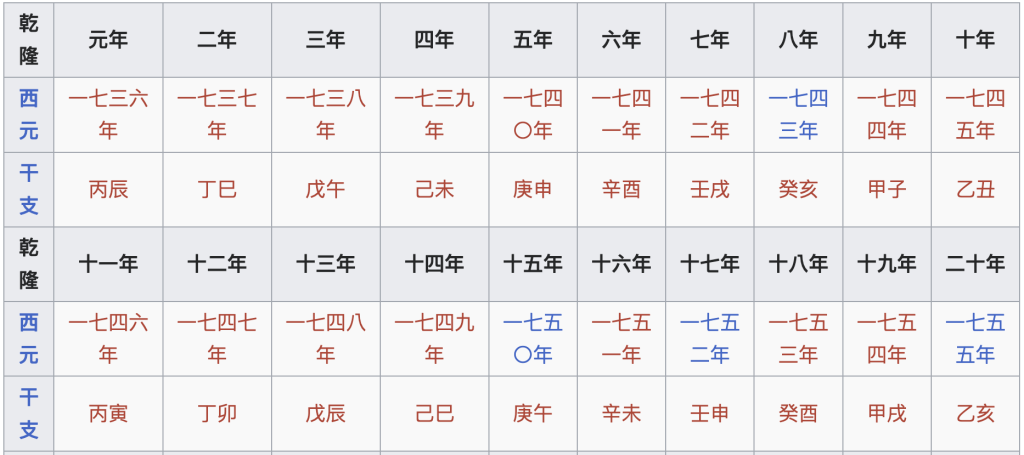
As you can see, the 乙丑 year is in the top set of rows, the final column. Converting the corresponding cells from their Chinese character numbers, we will find that the 乙丑 (yǐ chǒu) year is Emperor Qianlong’s tenth year of reign (十年) and the Western calendar year of 1745 (一七四五年).
A table of the emperors of the Ming and Qing Dynasties has been compiled with links to their respective reign tables (a table such as the one above) here.