Qiankeng Village 前坑鄉
One of the few pieces of information I had to begin my research was the name of our ancestral village. This was passed down to us through tradition, spoken to my mother by her father and written down when she began to try and reconstruct our family tree. Our ancestral village was recorded as follows:
泉洲府晋江杲十九都前坑鄉
泉洲府 means Quanzhou Prefecture.
晋江杲 means Jinjiang County.
十九都 means the 19th Township.
前坑鄉 means Qiankeng Village.
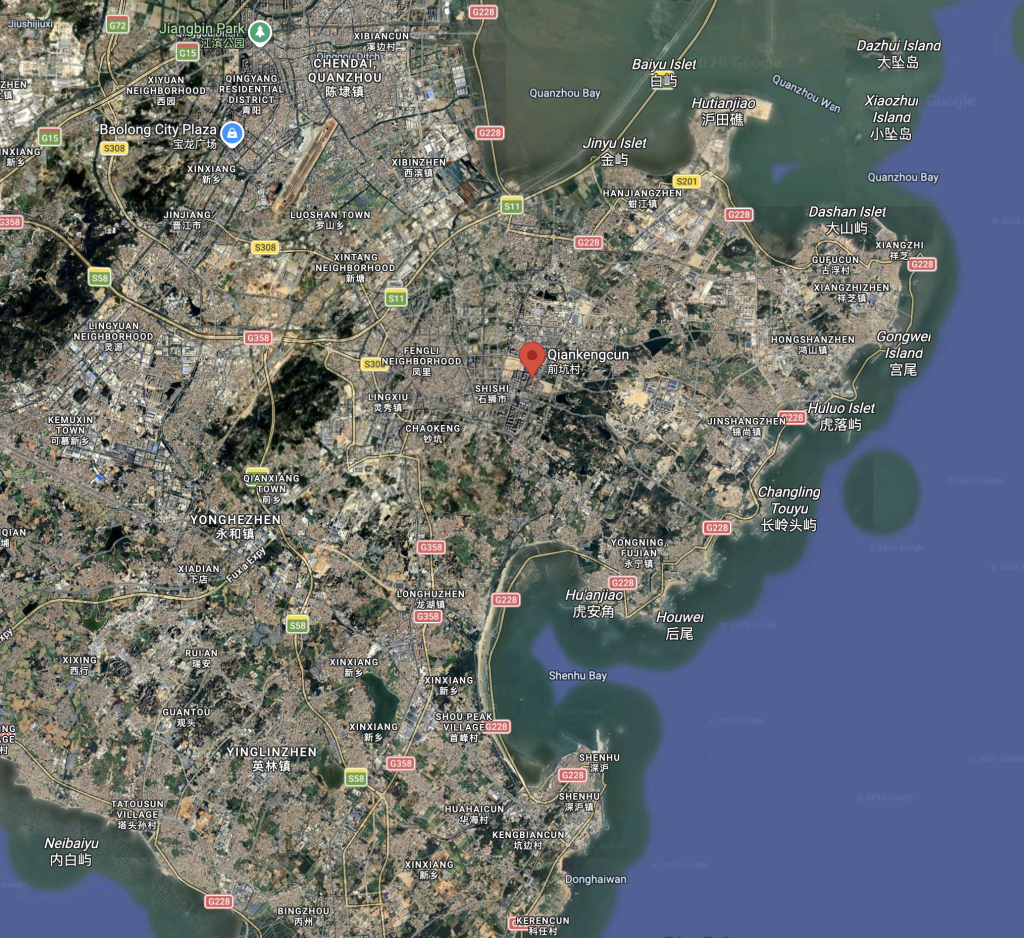
Quanzhou Prefecture 泉洲府
Located just across the Taiwan Strait in souther Fujian Province, Quanzhou is a prefecture-level port city with a deep bay and several rivers, making it a major port used for centuries (source).
Jinjiang County 晋江杲
This county was originally established in 720 AD during the Tang Dynasty by separating it from the Nan’an County of Quanzhou. There were many changes to its boundaries, jurisdiction, and nicknames throughout the years, but most pertinent to this research is the fact that in December 1987, the areas including the 19th Township 十九都 were separated to establish current-day Shishi County 石狮市.
the 19th Township 十九都
The character 都 is most often pronounced dōu in modern Chinese with the meaning of ‘all’, but it can also be said as dū, which is usually translated as ‘capital’ or ‘metropolis’.
During the Yuan Dynasty, there was a reformation of the local system of governance, and the new system was called the Dutu 都图 System 制. Essentially, this system took local villages and townships and took their existing leadership and formalized it into hierarchical geographical units for the purposes of organizing tax collection and maintaining records. This system continued through the Ming and Qing Dynasties. During the Qing Dynasty, Jinjiang County 晋江杲 had forty-nine dū 都, which were further divided into 137tú 图, each containing ten jiǎ 甲 that were comprised of ten households (source).
Qiankeng Village 前坑鄉
Qiankeng Village 前坑村 is a small town of about 1,800 people currently under the jurisdiction of the larger Baogai Town 宝盖镇. The character currently used to mean ‘town’ is cūn 村, but the original character recorded in our personal records is xiāng 鄉, which means ‘home village’, likely indicating a place of origin.
Learning the name of your ancestral village or hometown can provide vital clues to discovering more about your family history. Since there are many different families with the same surname, the ancestral village is a critical distinguishing feature that is used to distinguish one branch from the next.